
Legacy System Modernization Without a High-Risk Rewrite
A staged legacy system modernization approach based on business capability, seams, data control, incremental replacement, and measurable risk reduction.
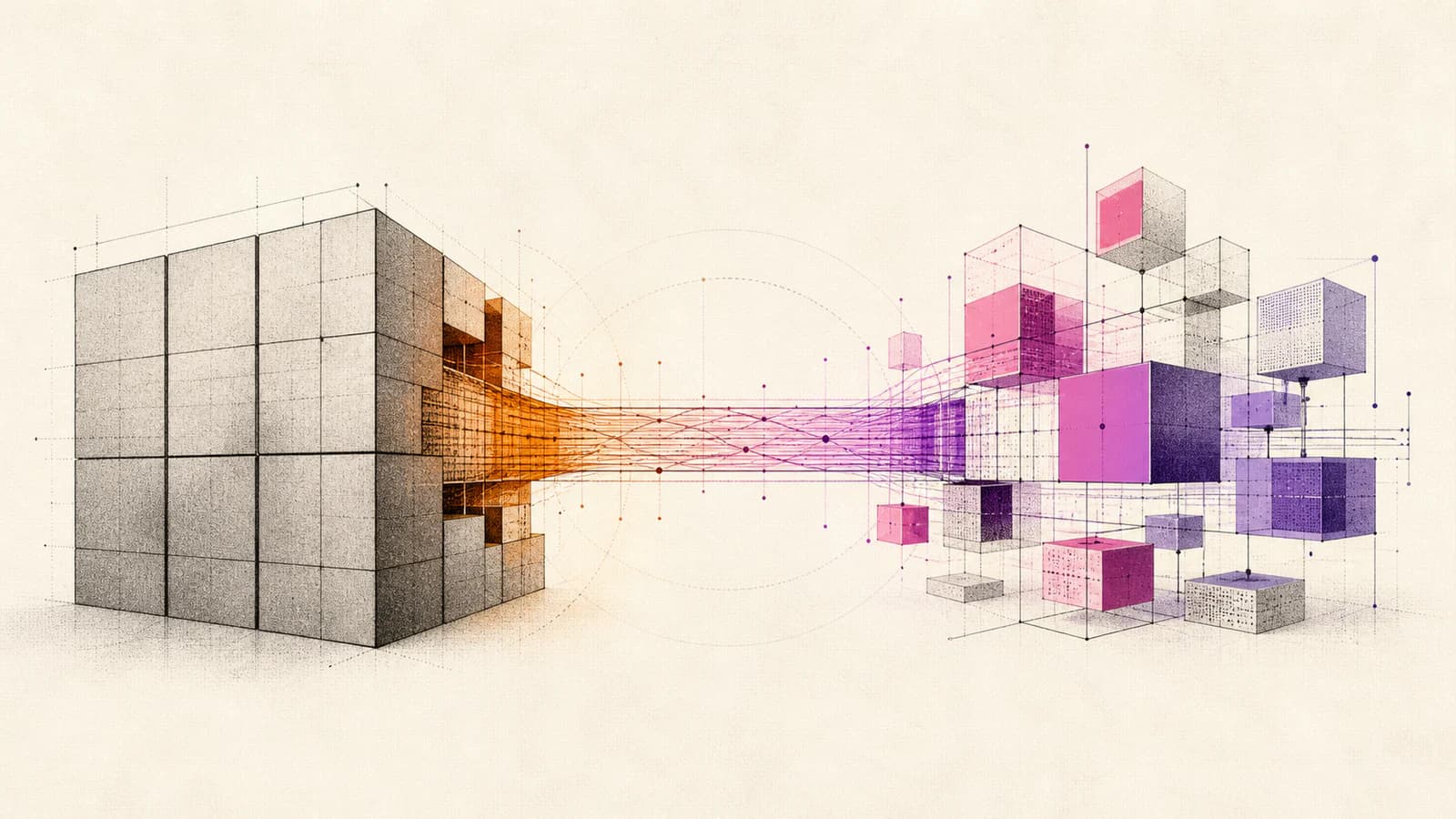
A staged legacy system modernization approach based on business capability, seams, data control, incremental replacement, and measurable risk reduction.
Legacy systems are rarely obsolete in every dimension. They may contain fragile technology alongside years of encoded business rules, trusted reports, operational habits, and critical data. Replacing everything at once concentrates technical, organizational, and migration risk into a single event.
A safer modernization program identifies the constraints that matter, creates seams around valuable capabilities, and moves responsibility in controlled increments. The goal is not to preserve old technology indefinitely; it is to reduce risk while continuing to serve the business.
Diagnose the real sources of risk
Inventory applications, infrastructure, interfaces, data stores, scheduled jobs, reports, users, vendors, and support knowledge. Distinguish age from risk. A stable older component with clear ownership may be less urgent than a newer service with no monitoring, weak access controls, or a dependency that is about to lose support.
Collect evidence from incidents, change lead time, security findings, recovery tests, performance, licensing, recruitment, customer impact, and manual workarounds. Map business capabilities to technical components so priorities reflect service consequence rather than the loudest technology complaint.
- Record undocumented rules discovered in code, data, reports, and operator behavior.
- Identify single points of failure in people as well as infrastructure.
- Test backups and recovery instead of assuming their presence equals recoverability.
Choose a treatment for each capability
Different areas may be retired, retained, rehosted, replatformed, refactored, replaced with a product, or rebuilt. Use one modernization label only after considering business differentiation, change frequency, risk, integration needs, and total ownership. A commodity capability may be better bought; a differentiating workflow may justify custom development.
Create decision records that state why a treatment was selected, its assumptions, and what would cause reconsideration. This prevents the program from becoming an ideological rewrite and helps finance and operations understand why visible progress may begin with boundaries, data, and observability rather than a new interface.
Create seams before replacing internals
Wrap unstable interfaces behind an explicit service or adapter. Introduce a façade for new consumers, capture contracts, and route selected use cases through the new boundary. This reduces direct dependency on legacy details and creates a place for validation, monitoring, and gradual migration.
Good seams follow business capabilities rather than arbitrary database tables. Avoid turning the legacy schema into a permanent public API. Where direct database access exists, identify readers and writers, then move them toward controlled interfaces before changing ownership of the underlying data.
- Measure traffic and behavior at the seam before redirecting it.
- Use feature controls to move cohorts or workflows incrementally.
- Keep a tested rollback route until the new path proves stable.
Treat data migration as product work
Profile source data for missing values, duplicates, invalid relationships, inconsistent codes, and historical exceptions. Define target semantics with business owners rather than copying columns mechanically. Decide what must move, what can remain archived, how records are matched, and how audit history is preserved.
Rehearse extraction, transformation, loading, reconciliation, and rollback using production-like volume. Dual writes can support transition but create consistency risk; if used, define authority and conflict handling. A migration is complete only when users and reports can rely on the target, not when a script finishes without an error.
Modernize delivery and operations alongside code
Improve version control, reproducible builds, automated tests, environments, deployment, monitoring, secrets, access, backups, and incident response. These capabilities reduce the risk of every later change. Moving unchanged software to new infrastructure may buy time, but it does not resolve unclear ownership or an unsafe release process.
Capture critical operational knowledge through pairing, runbooks, architecture records, and observable systems. Keep experienced operators involved in design and acceptance; their workarounds often reveal requirements absent from formal documentation. Modernization that excludes them can remove safeguards the new team did not know existed.
- Define service indicators for both old and new paths during transition.
- Practice failure and rollback before moving critical volume.
- Fund support for the legacy estate until its responsibilities actually end.
Retire deliberately and prove risk reduction
Set exit criteria for each migrated capability: traffic moved, data reconciled, reports validated, users trained, support ready, recovery tested, retention handled, and dependencies removed. Then disable access in stages and monitor before decommissioning infrastructure or contracts.
Measure modernization through reduced incident exposure, faster safe change, lower manual effort, clearer ownership, improved recovery, and retired dependencies. New technology is an output; the outcome is an organization that can operate and evolve an important capability with less risk.