
API Integration Checklist for Reliable Production Systems
A production API integration checklist covering contracts, authentication, data mapping, resilience, observability, testing, and ownership.
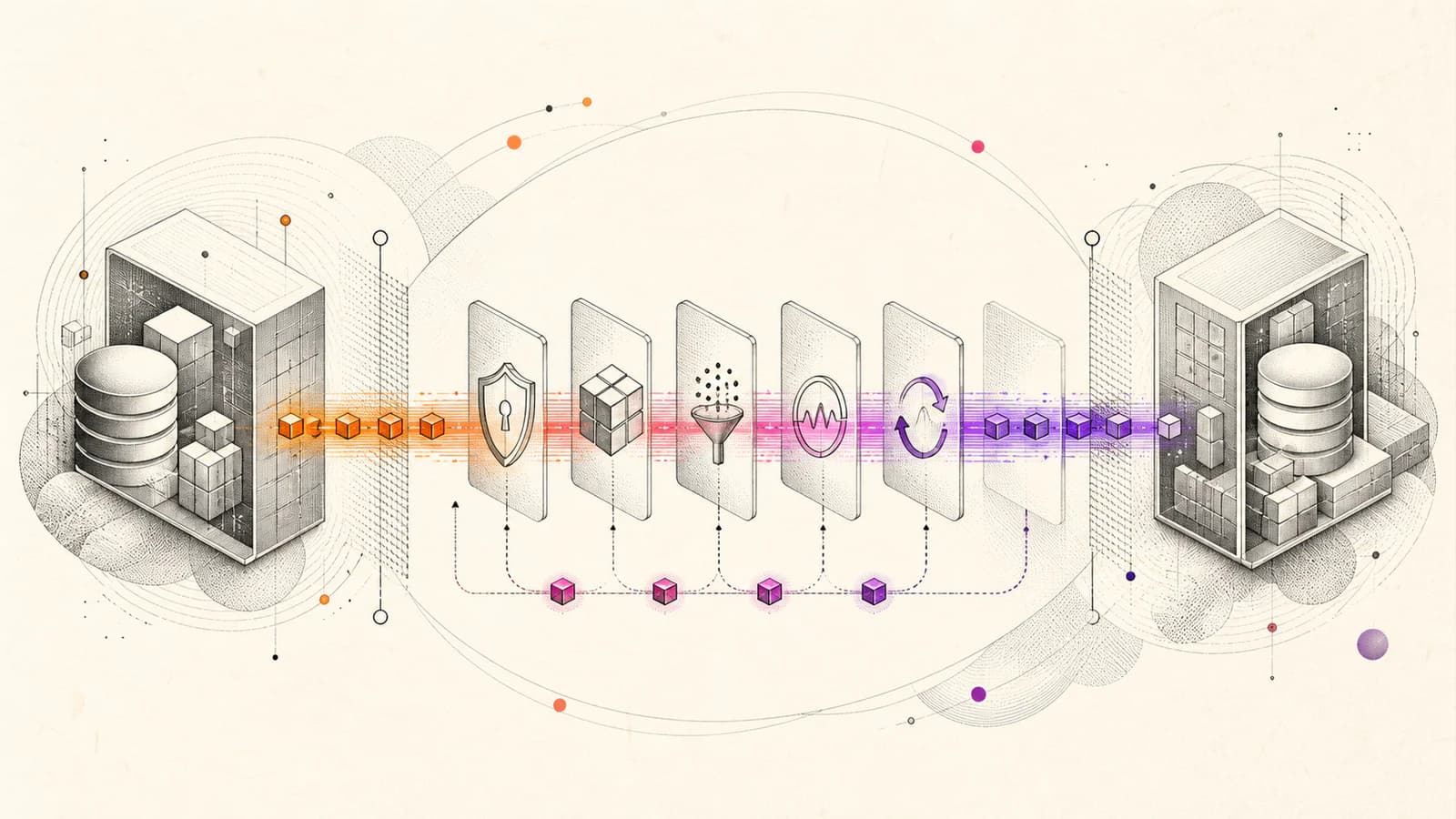
An API integration is production-ready when it can cope with the conditions outside the successful demo: expired credentials, partial data, duplicate events, timeouts, vendor changes, unavailable dependencies, and operators who need to understand what happened. The endpoint call is often the smallest part of the work.
Use this checklist to define the contract between systems and the operating model around it. The aim is not to add complexity everywhere, but to make failure proportionate, visible, and recoverable for the business process the integration supports.
Clarify purpose, authority, and ownership
Document the business workflow, systems involved, data exchanged, trigger, expected freshness, and consequence of delay or error. Name the authoritative source for every important field and decide whether the integration creates, mirrors, enriches, or commands records. Ambiguous authority produces loops and overwrites when both systems can edit the same concept.
Assign technical and operational owners on both sides. Record support channels, escalation expectations, maintenance windows, deprecation policy, rate limits, environments, and contract constraints. Vendor documentation is not an operating agreement; teams still need to know who responds when the dependency behaves differently from the documentation.
Define and validate the data contract
Specify fields, types, units, time zones, enumerations, identifiers, optionality, defaults, precision, encoding, and size limits. Map external identifiers to internal records without assuming names or email addresses are stable keys. Decide how deletions, merges, corrections, and late-arriving updates are represented.
Validate inputs at the boundary and retain enough context to diagnose rejected records safely. Be tolerant of harmless additions but explicit about incompatible changes. Versioning should reflect real contract evolution rather than leaving consumers to infer behavior from undocumented payload differences.
- Use representative examples for normal, empty, boundary, and invalid payloads.
- Normalize dates and money without discarding source precision or time zone meaning.
- Document field-level privacy and retention requirements.
Secure credentials and authorize actions
Choose an authentication mechanism supported for machine-to-machine use and scope credentials to the minimum required permissions. Store secrets in an approved secret manager, rotate them, separate environments, and avoid exposing them in browser code, logs, error messages, screenshots, or support tickets.
Authentication identifies the caller; authorization still needs to control records and actions. Validate webhook signatures and replay windows, restrict network access where appropriate, and treat provider callbacks as untrusted input. Audit high-impact operations with enough detail to reconstruct the decision.
Design for retries, duplicates, and partial failure
Set timeouts, bounded retries, exponential backoff, and jitter according to the operation. Retrying a safe read differs from retrying a payment or record creation. Use idempotency keys, stable event identifiers, or upsert rules so a repeated request does not repeat the business effect.
Choose synchronous calls only when the user genuinely needs an immediate answer. Queues can isolate temporary outages and smooth bursts, but they require dead-letter handling, replay controls, ordering decisions, and visibility into backlog. Define what the user sees when one system succeeds and another fails.
- Distinguish transient, permanent, authorization, validation, and rate-limit failures.
- Preserve failed work for controlled replay instead of silent loss.
- Prevent stale retries from overwriting newer authoritative data.
Test beyond the happy path
Use contract tests, integration tests against a supported sandbox, and end-to-end tests for critical workflows. Exercise missing fields, new fields, malformed payloads, pagination, large responses, timeouts, duplicates, out-of-order events, revoked credentials, rate limits, and dependency outages. Sandboxes can differ from production, so record those gaps.
Before release, test migration and backfill behavior with production-like volume and verify reconciliation. Provide a safe way to disable or degrade the integration without taking down unrelated product functions. Coordinate launch with both operational teams so errors are not discovered first by customers.
Operate the integration as a product dependency
Monitor success, latency, error class, retries, queue depth, rejected records, freshness, reconciliation differences, and approaching credential or certificate expiry. Correlate logs across systems using stable request or event identifiers while redacting personal and secret data.
Create runbooks for common failures, replay, vendor outage, contract change, and credential rotation. Review provider announcements and test upgrades before deadlines. A reliable integration has an owner, a lifecycle, and a retirement plan—not only code that happened to work when it was released.