
AI Customer Support with a Reliable Human Handoff
Design AI customer support around clear scope, safe escalation, context transfer, queue ownership, measurement, and continuous review.
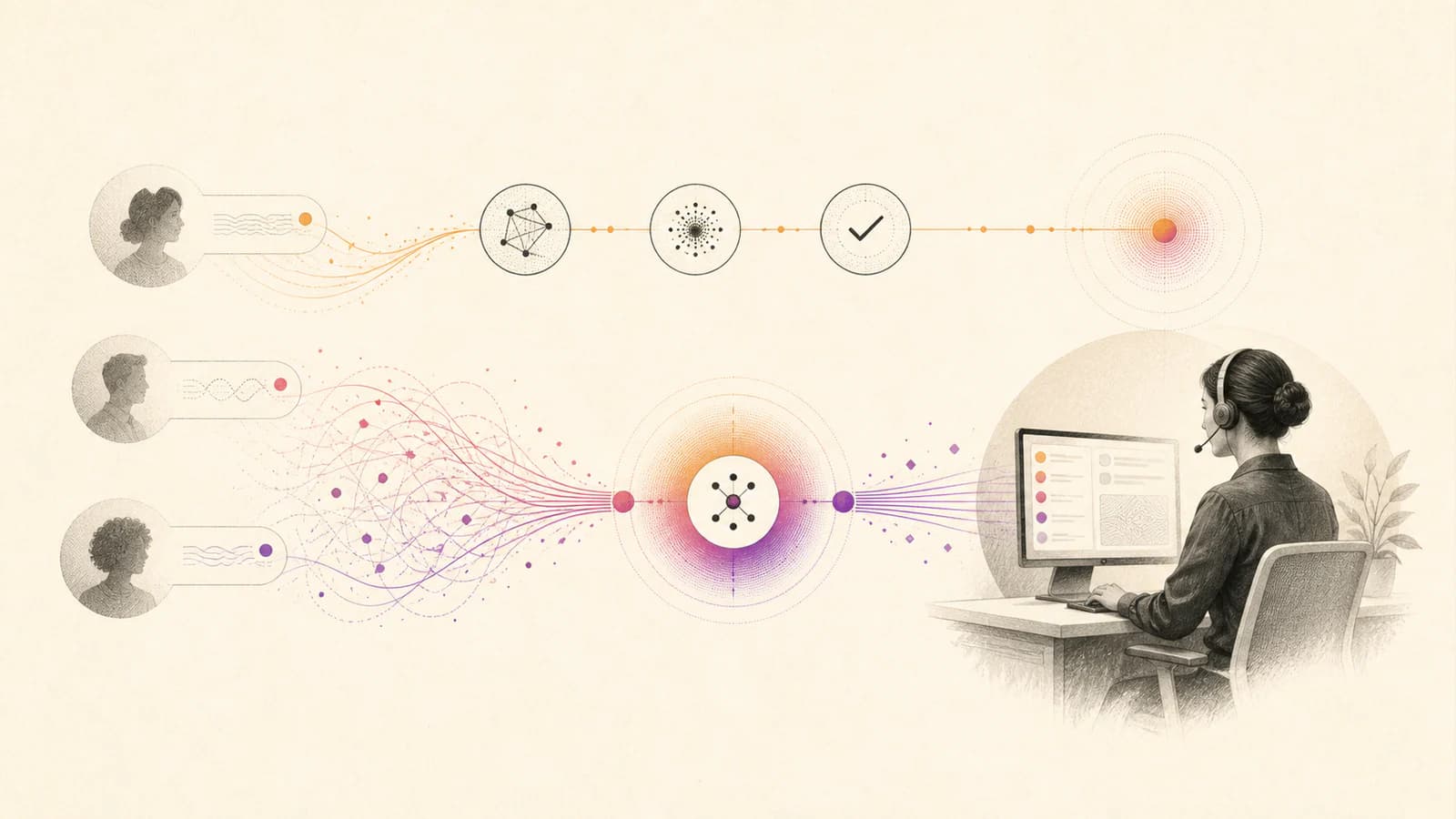
Design AI customer support around clear scope, safe escalation, context transfer, queue ownership, measurement, and continuous review.
AI customer support is most useful when it resolves bounded questions quickly and recognizes when the conversation needs a person. The handoff is not an escape hatch added after the assistant is built. It is a core workflow involving customer expectations, identity, conversation context, queue routing, staff tools, and responsibility for the final outcome.
A reliable design makes automation visible, gives customers a practical route to human help, and equips the receiving agent to continue rather than restart the conversation. That combination protects trust while allowing automation to handle work it can perform consistently.
Define what the assistant may and may not do
Start with a narrow service scope grounded in actual support demand. Classify intents by frequency, consequence, data sensitivity, answer stability, and whether an action changes a customer account. Frequently asked policy questions may be suitable; ambiguous complaints, safety concerns, complex billing disputes, and irreversible account changes may require early human involvement.
For each supported intent, define approved information sources, required authentication, allowed actions, refusal behavior, and escalation conditions. Avoid presenting generated guidance as a guaranteed company decision. The assistant should state uncertainty honestly and never invent a resolution when an authoritative system or policy does not provide one.
- Maintain an explicit capability registry rather than relying on a broad system prompt.
- Separate informational answers from actions that change data or commitments.
- Review sensitive and high-consequence intents with operational owners.
Recognize escalation signals early
Escalation can be triggered by customer request, unsupported intent, repeated misunderstanding, low confidence, authentication failure, system outage, policy exception, negative sentiment, accessibility need, or a risk keyword. Use deterministic rules where consequences are high and model-based classification only where errors can be managed.
Do not force customers through several failed turns before showing a human option. A visible route to assistance is especially important when the assistant is uncertain. Preserve alternate contact paths for people who cannot or do not want to use the automated channel.
Transfer useful context, not an opaque transcript
The receiving agent needs the verified customer identity, detected intent, concise summary, actions already attempted, relevant account or order references, source material used, unresolved question, and any promised next step. The full transcript should remain available, but it should not be the only context because reading it delays the response and encourages the customer to repeat information.
Label generated summaries as generated and let agents inspect the underlying conversation. Distinguish customer statements from system facts. Avoid transferring sensitive information into tools or channels that are not approved to hold it, and follow retention rules for both transcripts and derived summaries.
- Carry structured fields alongside the conversation summary.
- Show which details are verified, inferred, or still missing.
- Record automation actions so an agent does not repeat or contradict them.
Design queue ownership and customer expectations
A handoff is not complete when a ticket is created. Route it to a queue with an owner, priority rules, service expectations, working hours, fallback handling, and monitoring. If live transfer is unavailable, explain what will happen, what information has been saved, and how the customer will receive an update.
Prevent the bot from continuing as if it owns the case after escalation. The interface should show the new state clearly and allow the human agent to take control. If automation assists the agent privately with suggested answers, keep approval with the person and preserve accountability for the sent response.
Give support teams control and feedback tools
Agents need to correct summaries, change intent, report unsafe or inaccurate guidance, and identify missing knowledge. Operational teams need versioned content, approval workflows, test conversations, and release controls. Without those tools, defects become scattered anecdotes and the assistant cannot improve safely.
Review transcripts through a privacy-aware sampling process. Look for unresolved issues, unnecessary escalation, false confidence, policy drift, repeated customer effort, and agent rework. Turn findings into changes to knowledge, workflows, routing, or product design rather than treating prompt wording as the only lever.
- Create a fast path for agents to flag harmful or materially wrong responses.
- Test changes against representative conversations before release.
- Keep a rollback path for knowledge and orchestration changes.
Measure resolved outcomes and trust
Deflection alone rewards conversations that never reached a person, even when the customer gave up. Measure verified resolution, repeat contact, escalation quality, time to appropriate ownership, customer effort, agent rework, containment by intent, and safety incidents. Segment results because an average can hide a weak experience for a critical group.
Treat launch as controlled service change. Begin with bounded intents, monitor closely, and expand only when evidence shows reliable outcomes. The goal is not to keep humans out of support; it is to use automation where it helps and connect customers to capable people without losing time, context, or trust.